The Breakdown
How to make ads that look like breaking news
In February 2025, Nature Medicine published a study out of the University of New Mexico: microplastic concentrations in human brain samples had climbed about 50 percent...
Colin Elefante-Smith · 2026-08-31 · 3 min read
In February 2025, Nature Medicine published a study out of the University of New Mexico: microplastic concentrations in human brain samples had climbed about 50 percent in eight years.
The coverage compressed it into one image:
*Your brain now holds about a plastic spoon's worth of plastic.*
That spoon was everywhere for a couple of weeks: a photo and a condensed all-caps headline from a source you already trust.
For better or worse, that’s how a whole generation gets their news now: from aggregator pages reposting the scariest scientific findings of the week.
Remember that as you look at this ad. Whoever built it clearly did.
## 1. It's dressed as a news post.
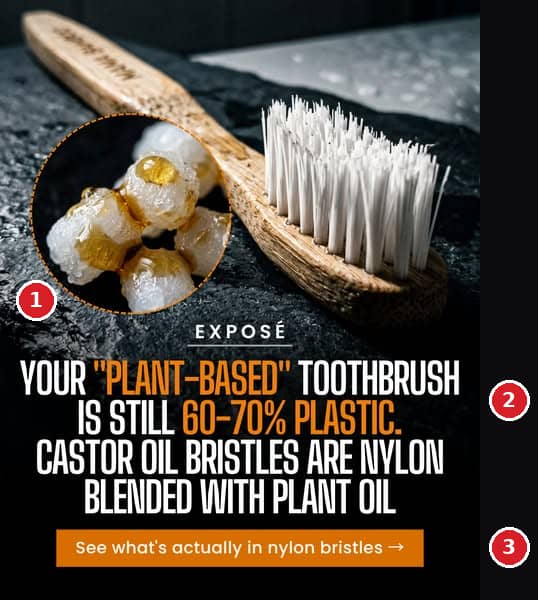
PRIMALS sells natural-bristle toothbrushes (boar or horse hair on a bamboo handle), and this ad runs under a page called The Microplastic Crisis.
Now look at the layout of the ad itself. A circle inset over a full-bleed photo. A one-word kicker, EXPOSÉ. A condensed all-caps headline with the key phrase in an accent color.
That's the anatomy of the big news-aggregator posts on Facebook and Instagram, Pubity and its cousins. The ad commits to every element, from the composition down to the headline font.
Inside the circle, the bristles are magnified to show wet amber granules, blown up until they look like something you'd never willingly put in your mouth.
The reader files it under the same type of news post that taught her to fear microplastics in the first place.
## 2. The headline picks its reader.
This isn’t for the person still brushing with a drugstore plastic brush. It’s for the one who already switched to bamboo, paid more for it, and probably told a friend.
That’s why “60-70% plastic” and “castor oil bristles are nylon blended with plant oil.” are key details. They make the core claim more believable for this more sophisticated health audience.
## 3. The click doesn't break character.
The CTA reads "See what's actually in nylon bristles."
Click through and you land on an article: "Bombshell Study Reveals: 2.3 Million Microplastic Particles Released Yearly From Plastic Toothbrushes Alone." Byline, date, PubMed citations. The product doesn't appear until several screens of studies and symptoms have gone by.
The ad is dressed as a news post. The landing page is dressed as the article that post would link to.
The framing holds from the feed to the checkout, and the reader stays in learning mode the whole way down.
## How I'd Beat It
There's one test that could make this problem-aware static convert even better.
**Trade the composition claim for the decay claim.**
"60-70% plastic" is a fact about an object on a shelf. It's equally true whether she bought that brush this morning or two years ago, which makes it easy to read, agree with, and forget.
This same Facebook page runs a second static built on a different photo: a single bristle under an electron microscope, smooth on the left, cracked and flaking on the right. The copy names the problem. "Left side is day one. Right side is after a month of normal brushing. Same bristle. Same toothbrush."
That's a claim about process. *The bristle is coming apart as you use it.*
I'd test that image inside the magnifier circle and keep the headline as it is. Same layout, same reader, but now there’s urgency around making the switch.
---
Ads like this only work when you can recreate the exact format your buyer trusts for information about their problems. Generic AI ad makers can't do that part for you.
---
**Want this done for your brand?**
One call will show you where your creative is leaving money on the table.
[Book a call](https://cal.com/colinelefante/ad-oven-discovery-call)