The Breakdown
The ad that insults its own product
In 1986, a Canadian cough syrup company put the founder's son on camera to tell people the stuff tasted terrible.
Colin Elefante-Smith · 2026-07-31 · 5 min read
In 1986, a Canadian cough syrup company put the founder's son on camera to tell people the stuff tasted terrible.
W.K. Buckley Limited had been selling more or less the same formula since 1920, and by then the brand was fading. Sales sliding. Whatever edge it once had, the competition had copied.
So they put W.K.'s son Frank on transit ads across the country, leading with the worst thing about the product. "It tastes awful. And it works."
It quickly made Buckley's the best-selling cough syrup in Canada by volume, and the company credits that campaign with lifting its share of the cough and cold category by more than 10%.
Forty years later, it's still a winning tagline.
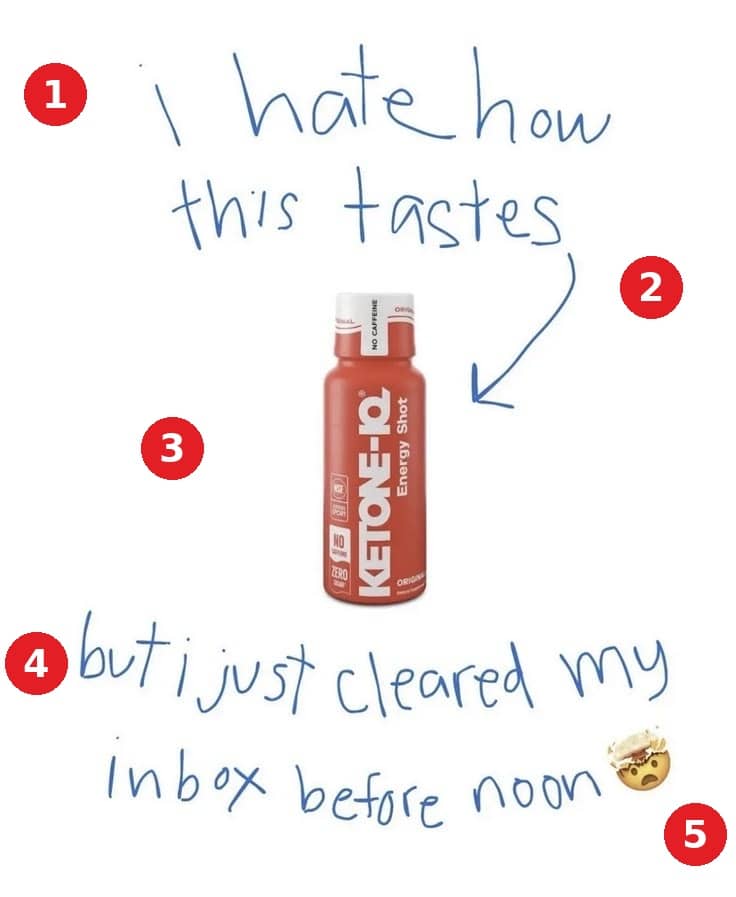
Ketone-IQ just ran the 2026 version of it, scrawled in blue on what looks like somebody's digital whiteboard.
## 1. The flaw buys the trust
"I hate how this tastes."
You believe it, because nobody trying to sell you something opens with the worst thing about it. One sentence and the ad has stopped sounding like an ad.
This is what's known as a "damaging admission". Copywriters have used the technique to disarm skepticism and build trust for decades. And the research supports it.
Hovland, Lumsdaine and Sheffield published the Army studies as Experiments on Mass Communication in 1949, and one of their findings was that two-sided messages, the ones that concede the other side, beat one-sided messages with audiences who started out skeptical or already knew the counter-argument.
## 2. The arrow
Without it, "this" is floating. With it, your eye gets dragged from the complaint down to the bottle and back up to the payoff, in that order.
That's a reading path. Usually you need a grid and a layout to build one. Here it's a squiggle that took four seconds.
## 3. The flaw is also the filter
Nobody buying this is shopping for a nice drink.
Ketone-IQ is a ketone shot from the company that used to be called HVMN and renamed itself in 2024. Closer to taking something than drinking it, and its buyer knows that going in.
So the opening line quietly sorts the room. Anyone who wanted a tasty energy drink is gone, and they were going to churn in a month anyway. What's left is the optimizer, the person who already decided that unpleasant and effective is a fine trade.
Their Ad Library backs it up. Right now the brand is running through Cameron Hanes, Tom Bilyeu, The Diary of a CEO. Hunt harder. Run farther. No crash. The absence of fatigue. Not one of those ads is promising it tastes good.
This handwritten note isn't a rogue creative. It's the positioning in one sentence.
## 4. "Cleared my inbox before noon" is a believable win
Not ten times the output, not a personal record. A Tuesday morning, a full inbox, done early. You can picture it in about half a second, and there's nothing in it to argue with, because it isn't a claim. It's a report.
Look at the register. Lowercase, no punctuation, "but i just." That's a text message. Nobody writes a headline that way, which is exactly why it doesn't read like one.
## 5. The ugliness is doing real work
Set that same sentence in the brand typeface, centered on a clean gradient. It becomes a claim, and you'd want to know who said it.
Scrawled in blue marker with a melting face emoji at the end, it's a person. The format matches the voice, and if those two disagree the whole thing collapses.
Ugly isn't laziness here. It's congruency.
## How I'd beat it
Two tests I'd run against this control.
First, flip the order. There's a wrinkle in the research worth knowing. Ein-Gar, Shiv and Tormala's "When Blemishing Leads to Blossoming" (Journal of Consumer Research, 2012) found the small-negative move lifts evaluations when the negative lands AFTER the positive, and stops working when it comes first. This ad inverts that on purpose, because in a feed there's no "after" if nothing stopped the scroll. Both readings are defensible, which is why it's worth a test: "i cleared my inbox before noon. i also hate how this tastes." Attention versus persuasion, settled with data.
Second, answer the crash. The note stops at the win, and a real one wouldn't. The loudest objection in this category is the crash, and Ketone-IQ obviously knows it, because their own partner ads run "No Crash" as a headline. I'd test one more handwritten line taking it off the table ("and no, i didn't crash at 3"). The format can carry it without breaking, and handling that objection costs nothing.
---
Admitting a flaw isn't the hard part.
It's knowing WHICH flaw your buyer will forgive. Taste is forgivable for someone chasing output. "Doesn't work" never would be. Get that call wrong and the same technique torches you.
---
**Want this done for your brand?**
One call will show you where your creative is leaving money on the table.
[Book a call](https://cal.com/colinelefante/ad-oven-discovery-call)