The Breakdown
The App Big Tech Tried to Ban
In 2011, the creators of South Park crashed a writing class at NYU while mtvU filmed it.
Colin Elefante-Smith · 2026-09-18 · 4 min read
In 2011, the creators of South Park crashed a writing class at NYU while mtvU filmed it.
Trey Parker gave the students one rule. Write down the beats of your story, and if the words “and then” fit between them, “you’ve got something pretty boring.”
What belongs between every beat is “but” or “therefore.”
“And then” gives you a list of things that happened. “Therefore” makes the next beat a consequence of the last one, and “but” throws something in its way. Either way the audience NEEDS the next beat, because the story stops making sense without it.
This is coming from the guys who write and ship a full South Park episode in six days, and it’s the check they run on their own outlines.
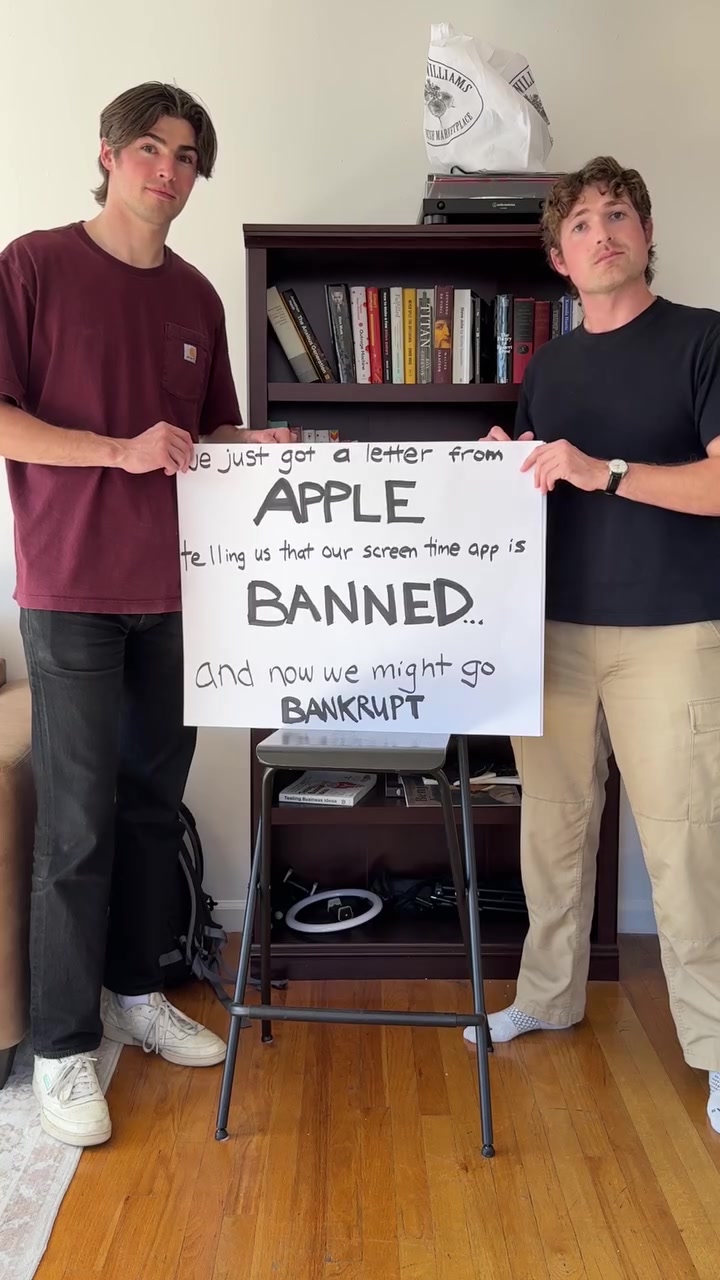
This ad from BePresent is a perfect example of what happens when you follow that rule. Let’s break it down:
1. The hook starts at the worst moment.
Two guys stand in front of a bookshelf holding a handwritten sign. Nobody speaks for the entire video.
The first board reads “we just got a letter from APPLE telling us that our screen time app is BANNED… and now we might go BANKRUPT.” APPLE and BANNED are the biggest words on it, so you get the stakes even if you only glance.
The next board says “all because we got over 1 MILLION PEOPLE off of their phones… here’s the story.”
That’s an open loop. You know how bad it got, and “here’s the story” promises to tell you how it happened. So you stay.
2. Every board pulls you to the next one.
Look at how the boards start:
- “but to get you…”
- “but because we were threatening…”
- “because out of nowhere…”
- “so we sent thousands of emails…”
There’s Parker’s rule. Each board is a consequence of the last one or a complication, and some of them trail off (“they ALSO began to notice…”) so the thought isn’t finished until the next board shows up.
You also can’t SKIM a sign somebody is holding. You get one thought at a time, at their pace.
And that’s all there is. There’s no voiceover and no music, just background room noise. It’s one of the least produced ads I’ve ever seen, and it runs for over a minute on nothing but the strength of the story and the copy written on those boards.
3. The sales pitch is hidden in the backstory.
BePresent is a screen time app that blocks your apps and rewards you with streaks and points for staying off your phone.
Now look at what the “story” boards are doing.
- “my brother and I QUIT our jobs at GOOGLE to build BePresent” is the credibility.
- “an app that uses the same PSYCHOLOGICAL TRICKS as SOCIAL MEDIA… but to get you ADDICTED to staying OFF of your phone” is the unique mechanism.
- “we helped 300K+ people finally find a solution to their PHONE ADDICTION” is the proof.
None of it reads as a pitch, because you think you’re still hearing how they got banned.
By the time the villain shows up, you already know who built the app, how it works and that it works.
4. The ban becomes the reason to buy.
The second half gives you a common enemy. “BIG TECH’s business model.” “APPLE BANNED us from the App Store and META FROZE our Ads.” (Yes, this is running as a Meta ad.)
Then the users come to the rescue. “the response was INCREDIBLE like… you guys went INSANE!” That’s social proof, and it’s written to “you guys,” so the viewer gets counted in the group that won.
Then comes the last line of the story:
“get the app Big Tech tried to BAN because it was too good”
The ban started as the crisis and ends as the proof. If the companies that make money from your screen time wanted this app gone, it probably works.
Steal this: Write your founder story as a chain. Start at the worst moment, then connect every beat with “but,” “so” or “because.” Put your credibility, your mechanism and your proof inside the backstory, so the selling is done before you ask for the click.
How I’d Beat It
I wouldn’t change much here. This story is obviously working for them (they use some version of it in most of their top ads) but there’s one thing I’d test at the very end:
Give “right now” a reason.
The last board says “DOWNLOAD BePresent right now!” Maybe it works, but by then the story has told me the fight is over. Big Tech backed down, and the urgency from the first board is gone by the time I’m asked to act.
I’d test a closing board that ties the download to the fight, something like “every download makes us harder to ban.” The viewer gets to join the side that won, and I’m willing to bet click-through rate would climb.
Want this done for your brand?
One call will show you where your creative is leaving money on the table.