The Breakdown
The chalkboard ad that schools you about your reflux
By 1920, Fleischmann's had a problem. Americans had stopped baking at home and yeast sales were sliding.
Colin Elefante-Smith · 2026-08-10 · 4 min read
By 1920, Fleischmann's had a problem. Americans had stopped baking at home and yeast sales were sliding.
So they hired a physician to study yeast, handed the findings to J. Walter Thompson, and quit selling it as an ingredient.
They sold it as medicine instead. The ads taught people about "intestinal fatigue." Yeast would clear your acne, fix your constipation, knock out your cold.
Sales tripled between 1917 and 1924. By 1927 Americans were buying 2.45 pounds of the stuff a year.
And yes, the FTC eventually showed up with a yeast-and-desist (sorry, I genuinely couldn't help myself), but the lesson still applies as long as you stay compliant.
## 1. There's no product in this ad
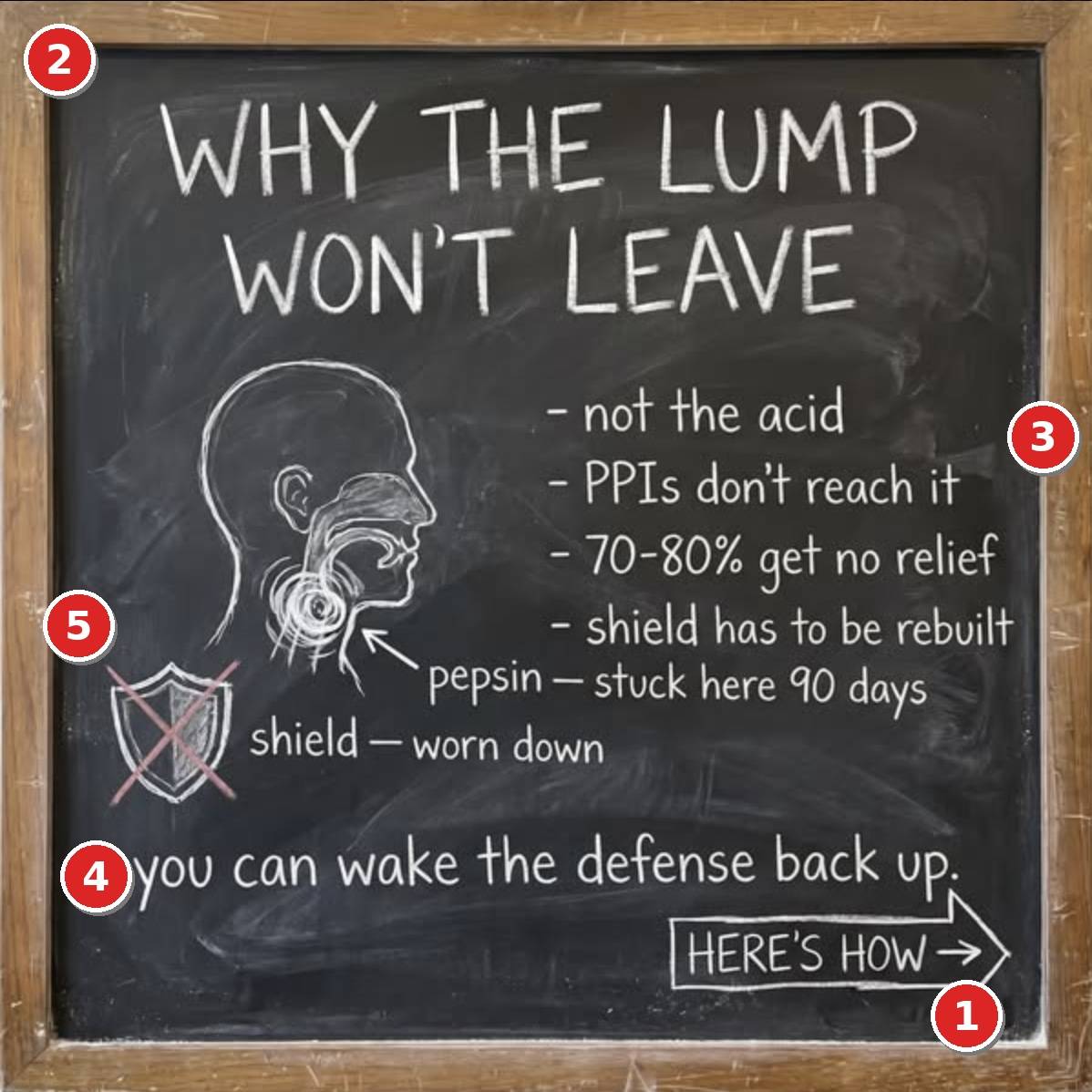
No bottle, no pill, no brand name, no logo. There's a chalkboard and an arrow.
It's running to people who don't know what's wrong with them. Lump in the throat for years, on acid medication the whole time, and nothing has improved.
So the ad doesn't sell. It diagnoses.
And "HERE'S HOW →" doesn't point at a product page, it points at an advertorial.
Once somebody accepts your explanation of their problem, the product stops being a decision.
## 2. Chalkboard, not whiteboard
Whiteboards read startup. Conference room, marker squeak, somebody's about to draw you a funnel.
A chalkboard in a wooden frame reads CLASSROOM.
Older, institutional, and somebody's teaching rather than pitching. Nobody expects a chalkboard to be sponsored.
## 3. Four bullets, and the entire argument is in them
Read them again.
- not the acid
- PPIs don't reach it
- 70-80% get no relief
- shield has to be rebuilt
Four persuasion moves, in order. Overturn the cause, disqualify the incumbent treatment, tell the reader she isn't the problem (the drug is), then name a new mechanism and imply it can be fixed.
That's a sales letter compressed onto a bar napkin. A whole VSL folded down to fortune-cookie size.
This is the most important element on the board, and the third bullet carries it. Somebody who's been failing treatment for six years just got told she's in the majority.
Notice they read like citations, too. A percentage range, a named drug class, a day count. Precision is what makes a claim feel like a diagnosis instead of a pitch (we'll come back to that).
## 4. The last line hands back control
Four bullets of bad news, then one full sentence: "you can wake the defense back up."
Look at what that verb assumes. Not "add this," not "replace that." WAKE. The machinery is already in you, it's just asleep.
That's much easier to accept than swallowing something foreign. It doesn't ask you to believe in a new substance, it asks you to believe in *your own body*.
## 5. The same chalkboard runs on four different diseases
The advertiser is Sproutly, a broccoli sprout extract supplement.
They rotate this exact template. Same frame, same crossed-out shield, same "HERE'S HOW" button, with the organ swapped: gastritis, H. pylori, SIBO, and so on.
And the ads don't run from a Sproutly page. They run from publisher-looking pages called "The Wellness Report" and "The Gut Lining Lab."
That isn't sloppiness. It's segmentation with a reusable art template bolted on top.
Same read we had on Headway's 1,789 ads a few issues back.
## How I'd beat it
Two tests against a control that's clearly working.
**Run the numbers you can defend.**
I went looking for the figures on that board. On PPIs, a meta-analysis of randomized trials put symptom response at 50% against 41% on placebo. Basically a tie, which is arguably WORSE for the drug than "70-80%," and it comes with a citation attached. In a category the FTC watches, I'd test the sourced version against the rounded one. Same argument, better numbers.
**Cut the drawing down.**
At feed size the anatomy sketch is the least legible thing on the board, and the crossed-out shield is a metaphor sitting next to real anatomy, so the eye changes registers mid-diagram. I'd test one arrow into one throat cross-section and nothing else. The bullets are carrying this ad. Let them.
Education-first native statics like these can be major assets at the top of the funnel. Chalkboards, whiteboards, hand-drawn diagrams, all of it can work.
But whether it gets a click or just a few seconds of attention depends on whether the MECHANISM underneath is one your buyer can believe and you can defend.
---
**Want this done for your brand?**
One call will show you where your creative is leaving money on the table.
[Book a call](https://cal.com/colinelefante/ad-oven-discovery-call)